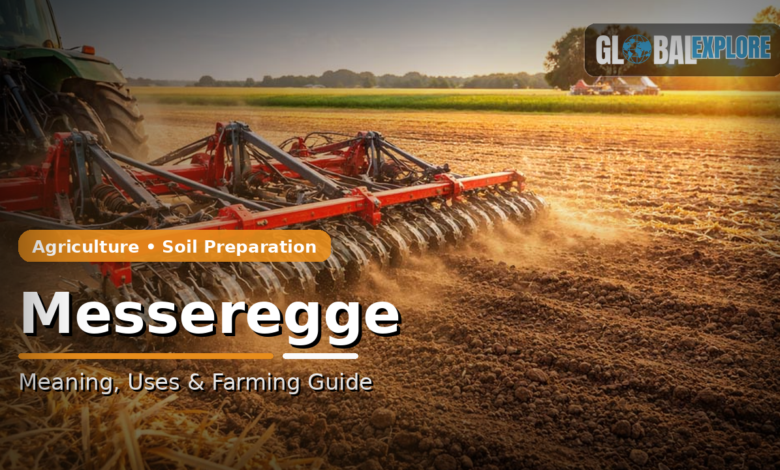
Messeregge is a German agricultural term most clearly understood as a knife-style harrow or blade-based soil preparation implement. In simple words, it refers to a farming tool designed to work the upper layer of soil, break clods, prepare a smoother seedbed, and support more even field preparation before planting.
The word may look unusual to English readers because it comes from German. The first part, Messer, means knife or blade. The second part, Egge, means harrow, which is a farm tool used to loosen, crumble, and level soil. When combined, Messeregge can be understood as a knife harrow or a harrow-like tool that uses blades or knife-style working parts.
However, the keyword has become confusing online because different websites describe it in different ways. Some explain it as a farming tool. Others present it as a communication concept, a digital system, an exhibition booth structure, a cultural place, or even a symbolic idea. Because of this, readers often ask a simple question: What does messeregge actually mean?
The most grounded answer is this: messeregge is best explained as a practical agricultural implement connected with soil preparation, especially in German-speaking farming and machinery contexts.
Why People Are Searching for Messeregge
People search for messeregge for several reasons. Some may have seen the word in a product listing, farming article, machinery catalog, or translated German text. Others may have found the keyword on a blog and want to know whether it is a real word or a newly invented online term.
The search intent behind the keyword is mainly informational. Users want to understand:
What messeregge means
Where the word comes from
Whether it is a real farming tool
How it is used in agriculture
Why different websites explain it differently
Whether messeregge has modern meanings outside farming
This article answers those questions in a clear and careful way. Instead of treating every online explanation as equal, it separates the strongest meaning from weaker or more speculative interpretations.
The Meaning and Origin of Messeregge
The word messeregge is best understood by breaking it into two parts:
Messer means knife or blade.
Egge means harrow.
A harrow is a farming implement used after plowing or during seedbed preparation. Its job is to break soil clumps, loosen the upper layer, smooth the surface, and create better conditions for planting. When the word Messer is added, it suggests a blade-based or knife-style version of that tool.
So, in plain English, messeregge means knife harrow.
This explanation makes practical sense because agricultural implements often get their names from the way they work. A disc harrow uses discs. A tine harrow uses tines. A chain harrow uses linked chains or flexible sections. A knife harrow or messeregge uses blade-like working parts to cut, slice, crumble, or level the soil surface.
Important point: Messeregge should not be confused with “Messe,” the German word often associated with trade fairs or exhibitions. Some online content connects messeregge with exhibition design because “Messe” means fair or trade show, but that is likely a misunderstanding when discussing the agricultural term. The more relevant root is Messer, meaning knife.
Messeregge in Agriculture
In agriculture, messeregge belongs to the wider family of soil preparation tools. It is used to improve the surface condition of a field before sowing, especially where farmers need a more even and workable seedbed.
A good seedbed matters because seeds need proper contact with the soil, balanced moisture, enough air, and a surface that is not too rough or compacted. If the soil is full of large clods, uneven ridges, or hard crusts, germination can suffer. A messeregge helps by working the upper layer and making the surface more consistent.
Farmers may use it after plowing, before drilling seed, or as part of a larger soil preparation setup. In modern machinery systems, a messeregge may be connected with rollers, front packers, or other implements to combine multiple actions in one pass.
The goal is not always deep cultivation. In many cases, the purpose is shallow, controlled soil work. That makes it useful where farmers want to prepare the surface without turning the entire soil profile upside down.
How a Messeregge Works in Soil Preparation
A messeregge works by using knife-like elements or blade-based sections to cut and break the soil surface. The exact design can vary depending on the manufacturer, width, and intended use, but the general principle is simple.
As the tool moves across the field, its working parts contact the topsoil. These parts help break larger clods, reduce unevenness, and create a more level surface. If used with a roller or packer, the field may also be lightly consolidated after the soil is crumbled.
This combination is useful because overly loose soil can dry out quickly or create poor seed placement. A well-prepared seedbed is not just soft; it should be firm enough to support seed-to-soil contact while still loose enough for root growth.
A messeregge can help with:
Breaking clods
Leveling the surface
Improving seedbed consistency
Reducing rough patches
Supporting more even planting depth
Preparing soil after earlier tillage work
The main value of messeregge is controlled surface preparation. It is not meant to replace every tillage tool, but it can be very useful when the goal is a clean, even, and workable field surface.
Main Uses of Messeregge in Farming
Seedbed Preparation
The most important use of a messeregge is seedbed preparation. Seeds need a stable environment to germinate properly. If the soil surface is too lumpy, uneven, or compacted, planting depth can become inconsistent. That can lead to uneven crop emergence.
A messeregge helps create a smoother top layer so planting equipment can place seeds more accurately.
Breaking Soil Clods
After plowing or heavier cultivation, fields often have larger soil clods. These clods can make planting difficult and reduce soil contact around seeds. A messeregge helps break down those clods into smaller particles.
This does not mean the soil should become powdery. Overworking soil can damage structure. The aim is a balanced surface: fine enough for planting, but not so fine that it becomes vulnerable to crusting or erosion.
Surface Leveling
Uneven soil can affect water movement, seed placement, and machinery performance. A messeregge can help smooth the upper layer of soil and reduce small ridges or rough areas.
This is especially useful before precision seeding, where consistent depth is important.
Supporting Reduced Tillage Systems
In some farming systems, farmers try to reduce deep soil disturbance. A messeregge can support this approach by focusing on the surface rather than aggressively turning deeper layers.
This can be useful in fields where maintaining soil structure, residue cover, or moisture is important.
Preparing Land with Front-Mounted Equipment
Some messeregge tools are designed for front mounting. This means they can be attached to the front of a tractor and used together with another implement at the rear. This setup can save time and improve field efficiency because more than one operation is completed in a single pass.
Benefits of Using a Messeregge
Better Seedbed Quality
A good seedbed can improve germination and crop uniformity. By breaking clods and smoothing the surface, a messeregge helps prepare a more reliable planting environment.
Efficient Field Preparation
When used correctly, a messeregge can reduce the need for repeated passes across the field. Fewer passes may save time, fuel, and labor.
Improved Soil Surface
Messeregge tools help manage the top layer of soil. They can reduce roughness and support more consistent planting conditions.
Compatibility with Other Implements
A messeregge may be used with rollers, packers, seed drills, or other cultivation equipment. This makes it a flexible part of a broader farm machinery system.
Support for Cleaner Planting
A more even soil surface helps planting machines work better. Seed depth becomes more consistent, and the crop may emerge more evenly.
Less Aggressive Than Heavy Tillage
Compared with deeper or more aggressive tools, a messeregge can offer a controlled way to improve the surface without unnecessary disturbance. This depends on soil type, field conditions, machine setup, and operator skill.
Messeregge vs Other Farming Tools
Messeregge vs Disc Harrow
A disc harrow uses angled discs to cut and mix soil. It can be more aggressive than a messeregge, especially when used at greater working depth. A messeregge is usually more focused on shallow surface preparation and clod breaking.
Use a disc harrow when deeper mixing or stronger residue incorporation is needed. Use a messeregge when the goal is surface refinement and seedbed preparation.
Messeregge vs Tine Harrow
A tine harrow uses metal tines to loosen soil and remove small weeds. It can be flexible and useful for lighter work. A messeregge, because of its knife-style concept, is more closely associated with cutting or breaking surface material.
A tine harrow may be better for light weed control or gentle soil movement. A messeregge may be better for breaking clods and creating a more uniform seedbed.
Messeregge vs Roller
A roller presses soil down and firms the surface. It does not usually break clods in the same way a blade-based implement can. A messeregge may be used before or with a roller so that the soil is both crumbled and reconsolidated.
The two tools can complement each other.
Messeregge vs Plow
A plow turns the soil over at a deeper level. It is a primary tillage tool. A messeregge is more of a secondary or surface preparation tool. It should not be viewed as a direct replacement for plowing in every situation.
The plow changes the soil profile. The messeregge improves the surface condition.
Modern Interpretations of Messeregge
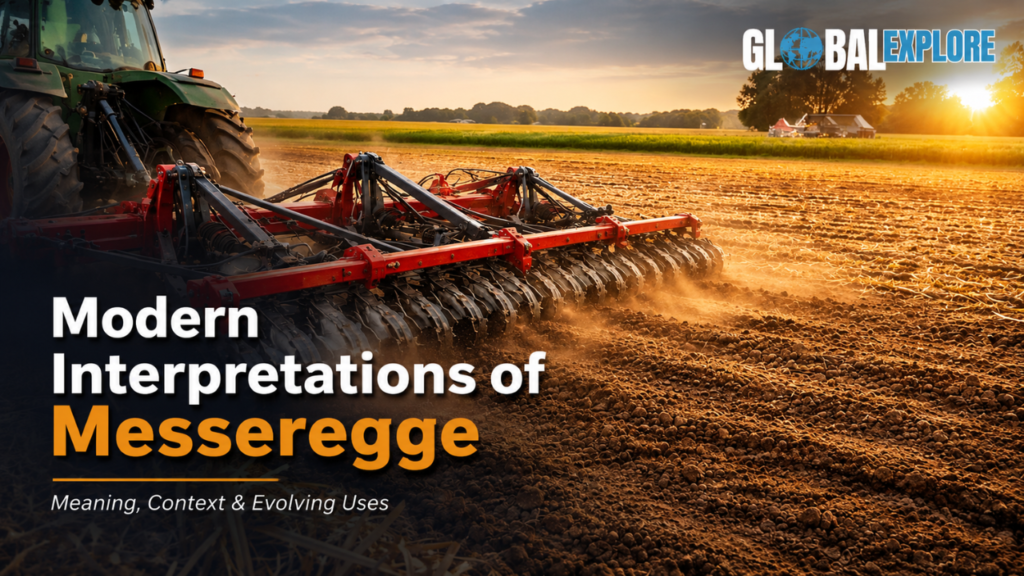
Because messeregge is an unusual word, some online writers have attached broader meanings to it. You may see it described as a communication method, a digital workflow idea, a branding concept, an exhibition design term, or a symbol of structure and precision.
These interpretations may be creative, but they should be treated carefully.
Messeregge as a Communication Concept
Some pages describe messeregge as a system for clear messaging or structured communication. This meaning is not as well supported as the agricultural meaning. It may be a modern content interpretation based on the similarity between “messeregge” and words like “message” or “messenger.”
If you see messeregge used this way, understand it as a metaphor rather than the core meaning.
Messeregge as an Exhibition Design Term
Some articles connect Messeregge with trade show booth edges or exhibition framing. This may come from confusion between Messer and Messe. In German, “Messe” can mean trade fair, while “Messer” means knife. Since the agricultural meaning depends on Messer + Egge, the exhibition explanation should not be presented as the main definition unless a specific industry source clearly uses it that way.
Messeregge as a Digital Branding Word
Some websites present messeregge as a modern digital term. This is more speculative. Unusual words can become brand names, product names, or conceptual labels, but that does not make them the original meaning of the term.
The safest explanation is this: messeregge is primarily an agricultural term, while many modern online meanings are secondary, symbolic, or speculative.
Common Misunderstandings About Messeregge
Misunderstanding 1: Messeregge Means Messenger
The word may look similar to “messenger” or “message,” but it is not the same. Messeregge is connected to German agricultural vocabulary, not English messaging.
Misunderstanding 2: Messeregge Comes from Messe
Some people assume the first part is “Messe,” meaning trade fair. That leads to exhibition-related explanations. But for the farming meaning, the stronger root is Messer, meaning knife.
Misunderstanding 3: Messeregge Is Only a Historical Word
The term may have older linguistic roots, but it is also used in modern agricultural machinery contexts. It is not only a museum word.
Misunderstanding 4: Messeregge Is a Brand Name
Messeregge is not best understood as one single brand. It describes a type or category of implement. Different sellers or manufacturers may use the term for specific models or parts.
Misunderstanding 5: Every Online Meaning Is Equally Reliable
This is not true. Some meanings are much better supported than others. The agricultural explanation has the clearest practical basis.
Practical Example of Messeregge Use
Imagine a farmer preparing a field after primary tillage. The soil has been turned, but the surface is uneven. There are clods, small ridges, and rough patches. If the farmer plants directly into that surface, the seed drill may place some seeds too deep and others too shallow.
The farmer attaches a messeregge to the front of the tractor and uses another implement behind it. As the tractor moves, the messeregge breaks larger clods and levels the front surface. The rear implement may further prepare, press, or seed the soil.
The result is a more even field surface, better seed placement, and a cleaner start for the crop.
This example shows why the tool matters. A messeregge is not just a piece of metal. It is part of a field preparation strategy where timing, soil condition, moisture, crop type, and machine setup all matter.
Who Should Know About Messeregge?
Farmers
Farmers who work with seedbed preparation, reduced tillage, or modern soil management may benefit from understanding what a messeregge does.
Agricultural Equipment Buyers
Anyone comparing machinery should know how a messeregge differs from rollers, harrows, cultivators, and other tools.
Agronomy Students
Students learning about soil preparation and cultivation systems can use messeregge as an example of specialized equipment terminology.
Translators and Researchers
Because messeregge is a German term, translators may come across it in machinery catalogs, manuals, product pages, or agricultural documents.
Content Writers
Writers covering the keyword should avoid vague definitions and explain the farming meaning clearly before discussing wider uses.
How to Choose the Right Messeregge
Choosing the right messeregge depends on your field conditions and machinery setup. A tool that works well in one soil type may not perform the same way in another.
Working Width
The working width should match your tractor power, field size, and other equipment. Common product listings may show widths such as 2600mm or 3000mm, but the best size depends on your farm setup.
Mounting Type
Some messeregge tools are front-mounted. This can be useful if you want to combine front soil preparation with rear-mounted equipment.
Soil Type
Heavy clay soil, sandy soil, loam, and stony fields all respond differently. A messeregge should be suitable for the soil conditions where it will be used.
Field Condition
If the field has large, hard clods, you may need stronger equipment or multiple steps. If the field only needs light finishing, a messeregge may be enough.
Compatibility
Check whether the tool works with your tractor, hydraulic system, linkage, roller, packer, or seed drill.
Build Quality
Look for strong frame construction, durable blades, replaceable wear parts, and reliable adjustment options.
Maintenance and Safety Tips
A messeregge should be maintained properly to perform well and last longer.
Inspect Blades and Working Parts
Check for wear, cracks, bending, or missing parts. Worn blades may reduce performance and create uneven results.
Tighten Bolts and Connections
Field vibration can loosen hardware. Regular checks help prevent damage and unsafe operation.
Clean After Use
Soil, stones, and crop residue can collect around the implement. Cleaning helps reduce rust and makes inspection easier.
Store Properly
Store the tool on firm ground, preferably under cover. Good storage protects metal parts and extends service life.
Follow Safe Transport Rules
Front-mounted implements can affect tractor balance and visibility. Use proper lighting, warning signs, and transport settings when moving on roads.
Avoid Overworking Wet Soil
Using any soil preparation tool in overly wet conditions can cause compaction, smearing, and poor structure. Wait for suitable soil moisture before working the field.
A messeregge performs best when the operator understands both the machine and the soil.
Frequently Asked Questions
1. What does messeregge mean?
Messeregge most commonly means a knife-style harrow or blade-based agricultural implement used for soil preparation. The word combines German roots connected with knife/blade and harrow.
Is messeregge a real word?
Yes, messeregge appears in agricultural machinery contexts. It is not a common everyday English word, but it is meaningful in German farming and equipment settings.
What is a messeregge used for?
A messeregge is used to break soil clods, prepare the upper soil layer, level the field surface, and help create a better seedbed before planting.
Is messeregge the same as a harrow?
It is related to a harrow, but more specific. A general harrow can have tines, discs, chains, or other working parts. A messeregge is best understood as a knife-style or blade-based harrow.
Why do some websites say messeregge is a digital concept?
Some websites use the word creatively or confuse it with similar-looking English terms such as message or messenger. Those meanings are less reliable than the agricultural explanation unless supported by a specific industry source.
Is messeregge useful in modern farming?
Yes, it can be useful for surface preparation, seedbed finishing, clod breaking, and working with front-mounted farming systems. Its value depends on soil type, field condition, and the farmer’s equipment setup.
Conclusion
Messeregge is best understood as a German agricultural term for a knife-style harrow or blade-based soil preparation implement. Its main purpose is to improve the upper layer of soil by breaking clods, leveling rough areas, and helping create a more consistent seedbed.
Although many online pages give different meanings to the word, the farming explanation is the most practical and reliable. Modern interpretations in communication, branding, or exhibition design may exist as creative uses, but they should not replace the core agricultural meaning.
For farmers, equipment buyers, researchers, and curious readers, understanding messeregge is useful because it shows how specialized farming tools support better field preparation. A well-used messeregge can help improve planting conditions, save time, and contribute to more efficient soil management.
If you enjoyed this article, read more about Brasssmile and Dental Search Intent
Updated: June 2026
Globalexplore.co.uk